Google

'Do Not Buy a Smartwatch Right Now' (droid-life.com) 113

Since Qualcomm is set to launch a new wearable chipset on September 10, Kellen from DoidLife argues against buying a new Google Wear OS-powered smartwatch in the meantime. The new chipset will be able to execute commands quicker, and provide for substantially longer battery life. From the report: This new chipset is said to be built from the ground up, will allow watches to look pretty when you aren't using them (like a normal watch sitting idly by your side), and extend battery life. More importantly, Qualcomm is betting that this Snapdragon Wear chip will "significantly change the Wear OS ecosystem, what you expect from a smartwatch." If you buy a smartwatch today, before Qualcomm announces this chip, you will be stuck with a 2+ year old Snapdragon Wear 2100 chip. All of the new Wear OS watches that have been announced recently, use that chip. It's old. It's never been great. And it's about to be replaced by something potentially game-changing for smartwatches. A report from WinFuture says that this new Snapdragon chip will be called the Wear 3100 and will allow for "Ok Google" detection even when the display is off. It is rumored to come with Google's Pixel-branded smartwatch, although DroidLife thinks that LG will be one of the first to launch a watch with this new processor. "This LG watch is said to have physical watch hands, as well as the smarts of Wear OS and a touch display," reports DroidLife. It is expected to make its debut on September 10.
Intel

Intel's 9th Gen Processors Rumored To Launch In October With 8 Cores (theverge.com) 233

According to a new report from Wccftech, Intel will introduce new Core i9, i7, and i5 chips on October 1st that will be branded as 9th generation processors. The Verge reports: The mainstream flagship processor, Intel's Core i9-9900K, is expected to ship with 8 cores and 16 threads. Leaked documents show that this will be the first mainstream Core i9 desktop processor, and will include 16 MB of L3 cache and Intel's UHD 620 graphics chip. Even Intel's 9th gen Core i7 processor is expected to ship with 8 cores and 8 threads (up from the current 6 cores), with the Core i5 shipping with 6 cores and 6 threads. Intel is reportedly launching its unlocked overclockable processors first, followed by more 9th generation processors early next year.
Privacy

Crestron Touchscreens Could Spy On Hotel Rooms, Meetings (wired.com) 21

An anonymous reader quotes a report from Wired: The connected devices you think about the least are sometimes the most insecure. That's the takeaway from new research to be presented at the DefCon hacking conference Friday by Ricky Lawshae, an offensive security researcher at Trend Micro. Lawshae discovered over two dozen vulnerabilities in Crestron devices used by corporations, airports, sports stadiums, and local governments across the country. While Crestron has released a patch to fix the issues, some of the weaknesses allowed for hackers to theoretically turn the Crestron Android touch panels used in offices and hotel rooms into spy devices.

Lawshae quickly noticed that these devices have security authentication protections disabled by default. For the most part, the Crestron devices Lawshae analyzed are designed to be installed and configured by third-party technicians, meaning an IT engineer needs to voluntarily turn on security protections. The people who actually use Crestron's devices after they're installed might not even know such protections exist, let alone how crucial they are. Crestron devices do have special engineering backdoor accounts which are password-protected. But the company ships its devices with the algorithm that is used to generate the passwords in the first place. That information can be used by non-privileged users to reverse engineer the password itself, a vulnerability simultaneously identified by both Lawshae and Jackson Thuraisamy, a vulnerability researcher at Security Compass.
There were also over two dozen other vulnerabilities that could be exploited to do things like transform them into listening devices. In addition to being able to remotely record audio via the microphones to a downloadable file, Lawshae was also able to remotely stream video from the webcam and open a browser and display a webpage to an unsuspecting room full of meeting attendees. "Crestron has issued a fix for the vulnerabilities, and firmware updates are now available," reports Wired.
Operating Systems

Samsung Unveils Tizen-Powered Galaxy Watch That Lasts 'Several Days' On Single Charge (venturebeat.com) 82

Alongside the Galaxy Note 9 and Galaxy Home Speaker, Samsung took the wraps off its new Galaxy Watch wearable at its Unpacked event in New York City. VentureBeat reports: Beyond coming in rose gold, silver, and midnight black colors, it can be had in two sizes -- the prior Gear S3 size is now called "46mm" and will start at $349.99, while a smaller-sized model is called "42mm" and will start at $329.99. Both will be available starting August 24, solely in the specific size and color configurations shown below. Samsung is also using improved glass: Gear S3 watches used Corning's Gorilla Glass SR+ and were IP68 rated for 10-foot, 30-minute water and dust resistance. The Galaxy Watch upgrades to Corning Gorilla DX+ glass and promises to keep the AMOLED screen underneath fully water-safe; it's rated for 5 ATM (165-foot/50-meter) submersion with IP68 and MIL-STD-810G certifications.

A disappointment in the new model is a reduction in its payment capabilities. The Gear S3 included both NFC and swipe-style magnetic secure transaction (MST) support to enable a wide array of Samsung Pay wireless purchases, but the Galaxy Watch drops MST support and only works with NFC. Not surprisingly, however, it does support Bluetooth 4.2 and 802.11b/g/n Wi-Fi. While continuing the use of a Tizen operating system from the Gear S3, Galaxy Watch packs a more powerful dual-core Exynos 9110 processor running at 1.15GHz. As was the case with the Gear S3 Frontier, the Galaxy Watch is available in Bluetooth-only and LTE versions, now promising LTE support across over 30 carriers in more than 15 countries. On stage, Samsung promised that the Galaxy Watch can be used for "several" days between charges; a subsequent press release said that it's actually "up to 80+ hours with typical usage" on the 46mm model, which has a 472mAh battery, versus "45+ hours" from the 270mAh battery of the 42mm model. Each model promises at least twice the longevity "with low usage."

Iphone

Apple Tells Lawmakers iPhones Are Not Listening In On Consumers (reuters.com) 214

An anonymous reader quotes a report from Reuters: Apple told U.S. lawmakers on Tuesday that its iPhones do not listen to users without their consent and do not allow third-party apps to do so either, after lawmakers asked the company if its devices were invading users' privacy. Representatives Greg Walden, Marsha Blackburn, Gregg Harper and Robert Latta wrote to Apple's chief executive Tim Cook and Alphabet chief executive Larry Page in July, citing concerns about reports that smartphones could "collect 'non-triggered' audio data from users' conversations near a smartphone in order to hear a 'trigger' phrase, such as 'Okay Google' or 'Hey Siri.'"

In a letter to Walden, an Oregon Republican who chairs the House Energy and Commerce Committee, Apple said iPhones do not record audio while listening for Siri wakeup commands and Siri does not share spoken words. Apple said it requires users to explicitly approve microphone access and that apps must display a clear signal that they are listening.

Android

Motorola Launches Verizon-Exclusive Moto Z3 Smartphone, 5G Moto Mod (phonedog.com) 52

Motorola unveiled their new flagship Moto Z3 smartphone today that's upgradeable to 5G. Like other Moto Z phones, the Z3 includes support for Moto Mods, including a new 5G Moto Mod that will let you use Verizon's mobile 5G network when it launches in 2019. The new Mod contains a Snapdragon X50 modem and 2,000mAh battery to help you stay connected to the 5G network. PhoneDog reports: The Moto Z3 is a Motorola phone that's exclusive to Verizon in the U.S. Specs for this Android 8.1-powered smartphone include a 6.01-inch 2160x1080 Super AMOLED screen and 8MP wide angle front-facing camera with f/2.0 aperture. Around back there's a dual rear camera setup with two 12MP cameras, one RGB and one monochrome, along with laser autofocus and portrait mode support. Inside the Moto Z3 lives an octa-core Snapdragon 835 processor along with 4GB of RAM, 64GB of built-in storage, and a microSD card slot. There's a 3000mAh battery and a USB-C port for recharging that battery, as well as support for Motorola's TurboPower solution to recharge in a hurry. Unfortunately, there's no 3.5mm headphone jack to be found here. All of those features are crammed into a body with a water repellent coating. Rounding things out is a side-mounted fingerprint reader and support for face unlock.
AI

Tesla Is Building Its Own AI Chips For Self-Driving Cars (techcrunch.com) 157

Yesterday, during his quarterly earnings call, Tesla CEO Elon Musk revealed a new piece of hardware that the company is working on to perform all the calculations required to advance the self-driving capabilities of its vehicles. The specialized chip, known as "Hardware 3," will be "swapped into the Model S, X, and 3," reports TechCrunch. From the report: Tesla has thus far relied on Nvidia's Drive platform. So why switch now? By building things in-house, Tesla say it's able to focus on its own needs for the sake of efficiency. "We had the benefit [...] of knowing what our neural networks look like, and what they'll look like in the future," said Pete Bannon, director of the Hardware 3 project. Bannon also noted that the hardware upgrade should start rolling out next year. "The key," adds Elon "is to be able to run the neural network at a fundamental, bare metal level. You have to do these calculations in the circuit itself, not in some sort of emulation mode, which is how a GPU or CPU would operate. You want to do a massive amount of [calculations] with the memory right there." The final outcome, according to Elon, is pretty dramatic: He says that whereas Tesla's computer vision software running on Nvidia's hardware was handling about 200 frames per second, its specialized chip is able to crunch out 2,000 frames per second "with full redundancy and failover." Plus, as AI analyst James Wang points out, it gives Tesla more control over its own future.
Android

Samsung's Tab S4 Is Both An Android Tablet and a Desktop Computer (arstechnica.com) 63

Today, Samsung unveiled the successor to the Galaxy Tab S3 from last year. The aptly named Galaxy Tab S4 features a 10.5-inch Super AMOLED display with a 2560 x 1600 resolution, Qualcomm Snapdragon 835 processor with 4GB RAM, 64GB internal storage (expandable via microSD card) and 13-megapixel f1.9 rear-facing camera. Unlike the Tab S3, it includes Samsung Dex software that lets users connect a Samsung mobile device to a monitor and then use the device as a pseudo-desktop. Ars Technica reports: The first Dex dock came out over a year ago and was designed to be used with Samsung smartphones. Users could plug their device into the dock, connect it to a monitor, pair a keyboard and a mouse, and use the setup as they would a full desktop PC. The system ran a version of Android that Samsung modified to better suit a desktop UI, which included a lock screen and a task bar area with app icons. Dex on the Galaxy Tab S4 works just like this, with a couple of extra features that leverage the power of a tablet. When connected to a monitor, both the big screen and the tablet's screen can be used simultaneously. In a short demo, Samsung showed how the device supports up to 20 open windows at once and how features like split screen and drag-and-drop can be used just as they would on a desktop PC. Users can launch Dex when not connected to a monitor as well, and that produces the same modified Android UI on the tablet's 10.5-inch, 2560 x 1600 Super AMOLED display. When connected to a monitor, both the big screen and the tablet's screen can be used simultaneously. In a short demo, Samsung showed how the device supports up to 20 open windows at once and how features like split screen and drag-and-drop can be used just as they would on a desktop PC. Users can launch Dex when not connected to a monitor as well, and that produces the same modified Android UI on the tablet's 10.5-inch, 2560x1600 Super AMOLED display. The tablet carries a $649 price, but includes all the specs mentioned above, as well as support for signature Samsung features like Air Command, translate, and off-screen memos, and a redesigned S Pen.
Cellphones

Huawei Passes Apple For Second Place In Smartphone Shipments (venturebeat.com) 166

An anonymous reader quotes a report from VentureBeat: For the first time in seven years, Samsung and Apple have not taken the top two positions in the worldwide smartphone market. All hail Huawei. Although Samsung held onto first place -- the South Korean giant typically dominates the first three quarters of the year, with the American company winning the fourth quarter -- Huawei passed Apple for second place this part quarter. The Q2 2018 figures come from IDC (though Canalys and Strategy Analytics both agree that Huawei passed Apple in the quarter).
Amiga

Commodore's Amiga Is Being Revived In Newly Updated Hardware (hothardware.com) 94

MojoKid writes from a report via Hot Hardware: Although it has been over three decades since the first Commodore Amigas were originally released, a fan base for the beloved systems is still going strong. In fact, today's Amiga community seems to be more active now that it has been in years, and a number of exciting new hardware projects have cropped up in recent weeks. Two relatively new projects, led by popular members of the Amiga community Paul Rezendes and John "Chucky" Hertell, are designed to breathe new life into the Amiga 4000 and Amiga 1200.

Both men set out to reverse engineer the motherboards for these systems, not only to continue the possibility of repairing existing machines that are prone to serious damage from leaky batteries and electrolytic capacitors, but to potentially spur additional customizations for the platform in the future. Though Paul and John have only made minor modifications to the Amiga 4000 and Amiga 1200 motherboard PCBs to this point, the possibility now also exists for all new variants to arrive at some point in the future for these machines as well. The first actual working motherboards populated with components based on the Amiga 4000 Replica project or Re-Amiga 1200 haven't been shown off just yet, and they may require additional revisions to work out any kinks. However, both projects are good examples of the passion that still remains for the beloved Amiga from computing glory days gone by.

Businesses

Logitech Is Acquiring Blue Microphones For $117 Million In Cash (theverge.com) 79

Logitech announced late Monday night that it is acquiring Blue Microphones for $117 million. The company known for USB condenser microphones, such as the Snowball and Yeti, will join Logitech's existing portfolio of brands. The Verge reports: Founded in 1995, Blue sells microphones that range in price from $60 to over $4,000 (for studio-grade hardware), and they're used by podcasters, musicians, and any other consumers who need higher-fidelity audio than what they get from the built-in microphones on their devices. Now, after dropping a heap of cash on the company, Logitech will do its best to make sure Blue's devices become just as essential as its own wireless keyboards and mice. "For Logitech, this is a new space," the company wrote in a blog post. "But, at the same time, it's not at all. Gamers are already using our Logitech G webcams to stream. People are video calling with friends and family thanks to Logitech every day. And in business, our audio and video know-how is apparent every time a video meeting takes place at the office. Joining up with Blue and their microphone lines is a logical adjacent opportunity with great synergies."
Robotics

OpenAI's Dactyl System Gives Robots Humanlike Dexterity (venturebeat.com) 22

An anonymous reader quotes a report from VentureBeat: In a forthcoming paper ("Dexterous In-Hand Manipulation"), OpenAI researchers describe a system that uses a reinforcement model, where the AI [known as Dactyl] learns through trial and error, to direct robot hands in grasping and manipulating objects with state-of-the-art precision. All the more impressive, it was trained entirely digitally, in a computer simulation, and wasn't provided any human demonstrations by which to learn. The researchers used the MuJoCo physics engine to simulate a physical environment in which a real robot might operate, and Unity to render images for training a computer vision model to recognize poses. But this approach had its limitations, the team writes -- the simulation was merely a "rough approximation" of the physical setup, which made it "unlikely" to produce systems that would translate well to the real world. Their solution was to randomize aspects of the environment, like its physics (friction, gravity, joint limits, object dimensions, and more) and visual appearance (lighting conditions, hand and object poses, materials, and textures). This both reduced the likelihood of overfitting -- a phenomenon that occurs when a neural network learns noise in training data, negatively affecting its performance -- and increased the chances of producing an algorithm that would successfully choose actions based on real-world fingertip positions and object poses.

Next, the researchers trained the model -- a recurrent neural network -- with 384 machines, each with 16 CPU cores, allowing them to generate roughly two years of simulated experience per hour. After optimizing it on an eight-GPU PC, they moved onto the next step: training a convolutional neural network that would predict the position and orientation of objects in the robot's "hand" from three simulated camera images. Once the models were trained, it was onto validation tests. The researchers used a Shadow Dexterous Hand, a robotic hand with five fingers with a total of 24 degrees of freedom, mounted on an aluminum frame to manipulate objects. Two sets of cameras, meanwhile -- motion capture cameras as well as RGB cameras -- served as the system's eyes, allowing it to track the objects' rotation and orientation. In the first of two tests, the algorithms were tasked with reorienting a block labeled with letters of the alphabet. The team chose a random goal, and each time the AI achieved it, they selected a new one until the robot (1) dropped the block, (2) spent more than a minute manipulating the block, or (3) reached 50 successful rotations. In the second test, the block was swapped with an octagonal prism. The result? The models not only exhibited "unprecedented" performance, but naturally discovered types of grasps observed in humans, such as tripod (a grip that uses the thumb, index finger, and middle finger), prismatic (a grip in which the thumb and finger oppose each other), and tip pinch grip. They also learned how to pivot and slide the robot hand's fingers, and how to use gravitational, translational, and torsional forces to slot the object into the desired position.

Transportation

Uber's Self-Driving Trucks Division Is Dead (techcrunch.com) 61

Uber is shuttering its self-driving unit, reports TechCrunch. The company will reportedly stop development of self-driving trucks and instead focus its efforts on self-driving cars. "We recently took the important step of returning to public roads in Pittsburgh, and as we look to continue that momentum, we believe having our entire team's energy and expertise focused on this effort is the best path forward," Eric Meyhofer, head of Uber Advanced Technologies Group, said in an emailed statement. From the report: Uber Freight, a business unit that helps truck drivers connect with shipping companies, is unaffected by this decision. "Rather than having two groups working side by side, focused on different vehicle platforms, I want us instead collaborating as one team, according to an email reviewed by TechCrunch that was sent by Meyhofer to employees. "I know we're all super proud of what the Trucks team has accomplished, and we continue to see the incredible promise of self-driving technology applied to moving freight across the country. But we believe delivering on self-driving for passenger applications first, and then bringing it to freight applications down the line, is the best path forward. For now, we need the focus of one team, with one clear objective." The company will pivot employees focused on self-driving trucks to other work that revolves around self-driving technology.
Software

The Next iPad Pros Will Shrink and Lose Their Headphone Jacks, Says Report (9to5mac.com) 219

According to supply chain blog Macotakara, the new iPad Pro models that will be introduced later this year will be slimmer, feature Face ID, and have no headphone jacks. 9to5Mac reports the details: First off, the report offers additional details on the 2018 iPad Pro dimensions. The 10.5-inch model is said to come in at 247.5mm (H) x 178.7mm (W) x 6mm (T), compared to the current dimensions of 250.6mm x 174.1mm x 6.1 mm. Meanwhile, the 12.9-inch iPad Pro is said to stack up at 280mm (H) x 215mm (W) x 6.4mm (T), which compares to the current-generation model at 305.7 x 220.6 x 6.9 mm. With these dimensions, it seems that Apple is focused more on reducing the overall footprint of the 12.9-inch model, fitting the same size display into a considerably smaller body. The report goes on to explain that Apple is likely to ditch the headphone jack with this year's iPad Pro models, a move the company first made with the iPhone 7. While Apple includes a Lightning to 3.5mm headphone adapter to ease the blow for iPhone users, it will not do the same for iPad Pro users, according to today's report.

Today's report corroborates that this year's iPad Pro models will feature Face ID, but it notes that there is no support for landscape Face ID as earlier reports had indicated. This presents an interesting problem for the iPad Pro, which is used commonly in landscape mode with accessories such as the Smart Keyboard. Macotakara notes, however, that Apple is moving the Smart Connector on this year's models to "the lower rear side -- close to the Lightning connector." What exactly this means is unclear, but the report explains that "the next iPad Pro Smart Keyboard may be changed to vertical position specifications." This is seemingly implying that the iPad Pro would dock vertically into the Smart Keyboard, but how that would work is vague at the moment.

Operating Systems

Magic Leap Offers a First Look At Its Mixed Reality OS (cnet.com) 50

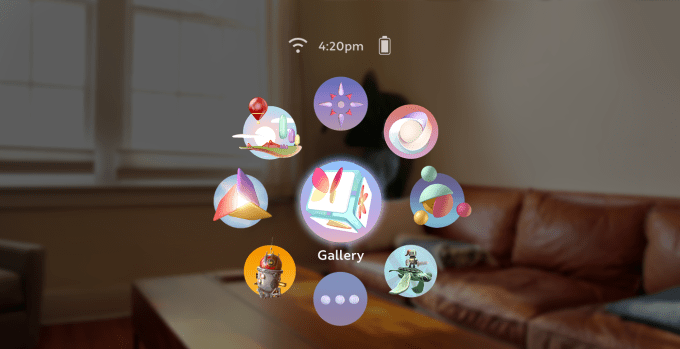
TechCrunch's Lucas Matney describes the Lumin operating system that will power Magic Leap's upcoming Magic Leap One mixed reality headset: Alright, first, this is what the Magic Leap One home screen will apparently look like, it's worth noting that it appears that Magic Leap will have some of its own stock apps on the device, which was completely expected but they haven't discussed much about. Also worth noting is that Magic Leap's operating system by and large looks like most other operating systems, they seem to be well aware that flat interfaces are way easier to navigate so you're not going to be engaging with 3D assets just for the sake of doing so. The company seems to be distinguishing between two basic app types for developers: immersive apps and landscape apps. Landscape apps like what you see in the image above, appear to be Magic Leap's version of 2D where interfaces are mostly flat but have some depth and live inside a box called a prism that fits spatially into your environment. It seems that you'll be able to have several of these running simultaneously. Immersive apps, on the other hand, like the game title, Dr. Grordbort -- which Magic Leap has been teasing for years -- respond to the geometry of the space that you are in and is thus called an immersive app.

Moving beyond apps, the company also had a good deal to share about how you interact with what's happening in the headset. Magic Leap will have a companion smartphone app that you can type into, you can connect a bluetooth keyboard and there will also be an onscreen keyboard with dictation capabilities. One of the big highlights of Magic Leap tech is that you'll be able to share perspectives of these apps in a multi-player experience which we now know is called "casting," apps that utilize these feature will just have a button that you can press to share an experience with a contact.

Intel

Intel's 10nm 'Cannon Lake' Processors Won't Arrive Until Late 2019 (digitaltrends.com) 149

At the company's second quarter 2018 financial results conference call, Intel chief engineering officer Venkata Renduchintala said the "Cannon Lake" 10mn processors won't appear in products until the 2019 holiday season. "The systems on shelves that we expect in holiday 2019 will be client systems, with data center products to follow shortly after," Renduchintala said. Interim CEO Robert Swan went on to tout the company's "very good lineup" of 14nm products. Digital Trends reports: "Recall that 10nm strives for a very aggressive density improvement target beyond 14nm, almost 2.7x scaling," Renduchintala said during the call. "And really, the challenges that we're facing on 10nm is delivering on all the revolutionary modules that ultimately deliver on that program." Although he acknowledged that pushing back 10nm presents a "risk and a degree of delay" in the company's road map, Intel is quite pleased with the "resiliency" of its 14nm roadmap. He said the company delivered an excess of 70 percent performance improvement over the last few years. Meanwhile, Intel's 10nm process should be in an ideal state to mass produce chips towards the end of 2019.

Intel's Cannon Lake chip is essentially a shrink of its seventh-generation "Kaby Lake" processor design. Given the previous launch window, the resulting chips presumably fell under the company's eighth-generation banner despite the older design. But with mass production pushed back to late 2019, the 10nm chips will fall under Intel's ninth-generation umbrella along with CPUs based on its upcoming "Ice Lake" design. Intel claims that its 10nm chips will provide 25 percent increased performance over their 14nm counterparts. Even more, they will supposedly consume 50 percent less power than their 14nm counterparts.

Bitcoin

Google Bans Cryptocurrency Mining Apps From the Play Store (bleepingcomputer.com) 111

The Google Play Store is no longer welcoming apps that mine cryptocurrencies on users' devices. The new policy plainly states: "We don't allow apps that mine cryptocurrency on devices." As a result, Google will start to remove any app from the Play Store that violates these terms. It will however still allow mining apps that are used to control cryptocurrency mining operations on remote devices -- such as servers or desktops. Bleeping Computer reports: Preventing cryptocurrency mining on Android is crucial because untethered mining operations can easily overheat or destroy batteries -- or even devices if the battery case deforms, leaks, or catches fire. Such scenarios have already happened. Android malware strains like Loapi and HiddenMalware have been known to cause physical damage to infected smartphones. Google didn't publicly announce the policy change, but developers who had apps removed complained on Reddit. Other policy changes were also made, such as the decision to ban apps with repetitive content. You can read the new "Restricted Content" section of the Play Store Policy Center here, and compare it to an earlier version here.
Businesses

Massachusetts Senate Passes Resolution To Do In-Depth Study On Right-To-Repair (vice.com) 108

An anonymous reader quotes a report from Motherboard: On July 25, the Massachusetts Senate approved a Resolution that would create a special commission that would research the feasibility of forcing device manufacturers to treat customers and independent repair shops the same as officially licensed repair outlets. According to the proposed study, that means providing customers and independent repair shops with "repair technical updates, diagnostic software, service access passwords, updates and corrections to firmware, and related documentation." Gay Gordon Byrne, executive director of The Repair Organization, helped push the bill in 2012 and has been working to extend the law to tech companies ever since. "This is just one step in a series of steps that will end Repair Monopolies for technology products. I'm thrilled," Byrne told me in an email about the pending study.

The Resolution to create the study group still needs to pass the Massachusetts House, but the session ends July 31 so right-to-repair watch dogs won't have to wait long to see if it goes forward. The proposed makeup of the study commission shows that the legislature is serious about the issue and also reveals how big tech's repair monopoly is about much more than just being able to open up your iPhone without voiding the warranty. The legislature wants the study commission to include 23 members, including various members of the legislature but also a wealth of experts in various tech fields. They want someone from the Massachusetts Farm Bureau, a medical device manufacturer, an expert on electronic waste recycling, someone who repairs complex medical equipment, an intellectual property lawyer, a cyber security expert, a local farmer, and various other experts and citizens affected or knowledgeable about the right-to-repair.

Intel

Leaked Benchmarks Suggest Intel Will Drop Hyperthreading From Core i7 Chips (arstechnica.com) 199

According to leaked benchmarks found in the SiSoft Sandra database, there is an Intel Core i7-9700K processor that doesn't appear to have hyperthreading available. "This increases the core count from the current six cores in the 8th generation Coffee Lake parts to eight cores, but, even though it's an i7 chip, it doesn't appear to have hyperthreading available," reports Ars Technica. "It's base clock speed is 3.6GHz, peak turbo is 4.9GHz, and it has 12MB cache. The price is expected to be around the same $350 level as the current top-end i7s." From the report: For the chip that will sit above the i7-9700K in the product lineup, Intel is extending the use of its i9 branding, initially reserved for the X-series High-End Desktop Platform. The i9-9900K will be an eight-core, 16-thread processor. This bumps the cache up to 16MB and the peak turbo up to 5GHz -- and the price up to an expected $450. Below the i7s will be i5s with six cores and six threads and below them, i3s with four cores and four threads. Even without hyperthreading, the new i7s should be faster than old i7s. A part with eight cores is going to be faster than the four-core/eight-thread chips of a couple of generations ago and should in general also be faster than the six-core/12-thread 8th generation chips. Peak clock speeds are pushed slightly higher than they were for the 8th generation chips, too.
Android

VLC Blacklists Newer Huawei Devices To Combat Negative App Reviews (theverge.com) 78

An anonymous reader quotes a report from The Verge: Some newer Huawei phones are actively being blocked from installing the open-source VLC media player app from Google Play. VLC's developers announced today that they're blacklisting some of Huawei's devices after unhappy users left too many one-star reviews for the app. But the negative reviews stem from a decision on Huawei's part and has nothing to do with VLC. The negative reviews are a result of Huawei's aggressive battery management and tendency to kill background apps, which directly affects VLC's background audio playback feature. Huawei users on VLC's forums are well aware of the issue. It's possible to manually disable these battery optimizations and have the app function properly in the background, but VLC claims that people often don't know how to do that, so they blame the app instead. The devices being blacklisted are the Huawei P8, P10, and P20. Users can still manually download the APK from VLC's website if they're interested in using the player.

Slashdot Top Deals