Media

Elon Musk: 'One In Billions' Chance We're Not Living In A Computer Simulation (vox.com) 951

An anonymous reader writes: At Recode's annual Code Conference, Elon Musk explained how we are almost certainly living in a more advanced civilization's video game. He said: "The strongest argument for us being in a simulation probably is the following. Forty years ago we had pong. Like, two rectangles and a dot. That was what games were. Now, 40 years later, we have photorealistic, 3D simulations with millions of people playing simultaneously, and it's getting better every year. Soon we'll have virtual reality, augmented reality. If you assume any rate of improvement at all, then the games will become indistinguishable from reality, even if that rate of advancement drops by a thousand from what it is now. Then you just say, okay, let's imagine it's 10,000 years in the future, which is nothing on the evolutionary scale. So given that we're clearly on a trajectory to have games that are indistinguishable from reality, and those games could be played on any set-top box or on a PC or whatever, and there would probably be billions of such computers or set-top boxes, it would seem to follow that the odds that we're in base reality is one in billions. Tell me what's wrong with that argument. Is there a flaw in that argument?" You can watch Elon Musk's full interview on YouTube.
Medicine

Samsung Unveils Gear Fit 2 Activity Tracker and IconX Wireless Earbuds (theverge.com) 25

An anonymous reader writes: At its New York City event today, Samsung unveiled two new wearables: an updated Gear Fit 2 activity tracker and IconX wireless earbuds. The Fit 2 features a thinner design than its predecessor, a curvier 1.5" Super AMOLED display, built-in heart-rate monitor, GPS, 4GB of built-in storage, and auto multi-sport and sleep tracking. Samsung promises three to four days of use on a single charge, and they are offering it in two sizes to appeal to male and female users. It's priced at $179, with in-store availability on June 10th. The IconX is Samsung's first truly wireless Bluetooth earbuds, featuring a built-in heart-rate monitor, and the ability to track one's distance and speed. The earbuds feature 4GB of storage, similar to the Fit 2, and are priced at $199 with a Q3 release date. Samsung notes that fitness bands comprise more than 50 percent of the wrist-worn device market, which is a way for the company to justify releasing new devoted fitness devices in addition to smartwatches.
Microsoft

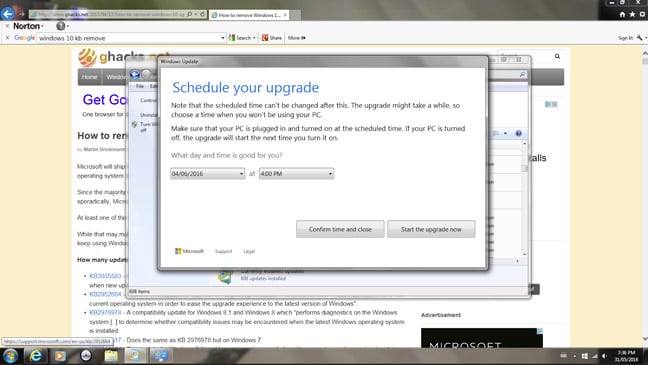
Microsoft Removes the 'X' From Windows 10 Update Leaving No Way Out (theregister.co.uk) 664

simpz writes: The Register reports that Microsoft has changed the Windows 10 update dialog and no longer shows the "X" close button. They say once agreed to there is no obvious back-out method and it is now out of step with Microsoft's own documentation on this. They have a screenshot of this. As noted above, the latest move is out of step with Microsoft's Knowledge Base documentation, which says you can re-schedule your upgrade.
Cellphones

Report: Average American Will Use 22GB of Mobile Data Per Month In 2021 (mashable.com) 104

An anonymous reader writes: According to Ericsson's latest Mobility Report, it's predicted that the average American smartphone subscriber will use 22GB of mobile data by the end of 2021. The report shows the explosion of mobile data consumption, with mobile traffic growing 60-percent between 2015 and 2016. It's forecasted that Western Europeans will use about 18GB per month per subscriber, while subscribers in the Asia Pacific region will use up about 7GB per month, even though it will have the largest share of mobile data traffic in 2021. The report claims smartphone subscriptions will overtake non-smartphone subscriptions in the third quarter of 2016. In 2021, 95-percent of all phones in North America will be smartphones. Fast 5G networks, which should start to be commercially deployed in 2020, will be able to handle the increased traffic and reach 150 million subscribers globally by the end of 2021. As for Internet of Things devices, the number of which will quadruple to 16 billion globally by 2021.
AI

Google's 'Project Magenta' Art Machine Composes Its First Song (thenextweb.com) 72

An anonymous reader writes: Google's Project Magenta, which aims to use machine learning to create music and art, just created its first song. The song, which can be more appropriately described as a 90-second melody, is quite simplistic and reminiscent of an old Nokia ringtone. It's impressive for a machine! Magenta is built on top of its TensorFlow system, and all the open-sourced materials one could ever need are available through its Github. The team wants to be able to tell stories from the art it creates similar to that of artists. "The design of models that learn to construct long narrative arcs is important not only for music and art generation, but also areas like language modeling, where it remains a challenge to carry meaning even across a long paragraph, much less whole stories," the team wrote. "Attention models like the Show, Attend and Tell point to one promising direction, but this remains a very challenging task."
Power

Elon Musk Suggests Tesla Model 3 Won't Get Free Supercharger Use (theverge.com) 228

An anonymous reader writes from a report via The Verge: In response to a question about how the company would handle an influx of Model 3s to its Supercharging stations, which are currently offered as a free service to Tesla customers, Elon Musk said at Tesla's annual shareholder's conference in Mountain View, California, "it will not be free long distance for life unless you purchase that package." He did not specify what the "package" contained, nor did he say how much it would cost as an add-on with the purchase of a Model 3. His full quote reads: "Obviously, [free Supercharging] fundamentally has a cost. [...] The obvious thing to do is decouple that from the cost of the Model 3. So it will still be very cheap, and far cheaper than gasoline, to drive long-distance with the Model 3, but it will not be free long distance for life unless you purchase that package. I wish we could, but in order to achieve the economics, it has to be something like that." Tesla did recently announce their Gigafactory Grand Opening will be held on July 29, even if it isn't scheduled to begin production on lithium ion cells until next year.
Microsoft

Windows Zero-Day Affecting All OS Versions On Sale For $90,000 (softpedia.com) 187

An anonymous reader writes: "A hacker going by the handle BuggiCorp is selling a zero-day vulnerability affecting all Windows OS versions that can allow an attacker to elevate privileges for software processes to the highest level available in Windows, known as SYSTEM," writes Softpedia. The zero-day is up for sale on a Russian underground hacking forum, and is currently available for $90,000 -- after it was initially up for $95,000. The hacker is saying he'll sell the zero-day to one person only, who'll receive its source code and a working demo. Two videos are available, one showing the hacker exploit Windows 10 with the May 2016 security patch, and another one bypassing all EMET features. While security experts think the zero-day may be overpriced, they think the hacker will find a buyer regardless.
AI

Facebook Spares Humans By Fighting Offensive Photos With AI (techcrunch.com) 127

An anonymous reader writes from a report via TechCrunch: Facebook tells TechCrunch that its artificial intelligence systems now report more offensive photos than humans do. Typically when users upload content that is deemed offensive, it has to be seen and flagged by at least one human worker or user. Such posts that violate terms of service can include content that is hate speech, threatening or pornographic; incites violence; or contains nudity or graphic or gratuitous violence. The content that workers have to dig through is obviously not great, and may lead to various psychological illnesses such as post-traumatic stress disorder. AI is helping to eliminate such a terrible job as it can scan images that are uploaded before anyone ever sees them. Facebook's AI already "helps rank News Feed stories, read aloud the content of photos to the vision impaired and automatically write closed captions for video ads that increase view time by 12 percent," writes TechCrunch. Facebook's Director of Engineering for Applied Machine Learning Joaquin Candela tells TechCrunch, "One thing that is interesting is that today we have more offensive photos being reported by AI algorithms than by people. The higher we push that to 100 percent, the fewer offensive photos have actually been seen by a human." One risk of such an automated system is that it could censor art and free expression that may be productive or beautiful, yet controversial. The other more obvious risk is that such a system could take jobs away from those in need.
China

Microsoft Sells 1,500 Patents To Xiaomi To Build 'Long-Term Partnership' (reuters.com) 66

An anonymous reader quotes a report from Reuters: Software maker Microsoft Corp is selling about 1,500 of its patents to Chinese device maker Xiaomi, a rare departure for the U.S. company and part of what the two companies say is the start of a long-term partnership. The deal, announced on Wednesday, also includes a patent cross-licensing arrangement and a commitment by Xiaomi to install copies of Microsoft software, including Office and Skype, on its phones and tablets. Wang said the acquisition of Microsoft patents, which included voice communications, multimedia and cloud computing, on top of some 3,700 patents the Chinese company filed last year, were "an important step forwards to support our expansion internationally." Florian Mueller, a patents expert who consulted for Microsoft in the past, said it was rare for Microsoft to actually sell its patents, adding "it's possible Microsoft found it easier to impose its Android patent tax on Xiaomi as part of a broader deal that also involved a transfer of patents."
Wireless Networking

Atari Is Going To Build IoT Devices (pcmag.com) 84

angry tapir quotes a report from Computerworld: The latest entrant in the Internet of Things is legendary gaming company Atari, which plans to make consumer devices that communicate over the SigFox low-power network. The devices will be for homes, pets, lifestyle, and safety. Atari has signed a deal with the communications service provider, Sigfox. "The initial product line will include categories such as home, pets, lifestyle and safety," the companies said in a statement. "By connecting to SigFox's global network, the products will benefit from its competitive advantages: a very long battery life and a simple solution that does not require local Internet connectivity and pairing. As soon as the battery is inserted in the object, it is immediately connected to the network."
Businesses

Panasonic To Stop Making LCD Panels For TVs (nhk.or.jp) 103

AmiMoJo quotes a report from NHK WORLD: Japanese electronics maker Panasonic says it will stop making LCD panels for televisions, giving way to fierce price competition. The pullout from TV LCD manufacturing follows the company's withdrawal from plasma TV production 3 years ago. They say they will continue to manufacture LCD panels at the plant for products other than televisions, such as medical equipment and cars. They say the company will keep making Panasonic-brand televisions, using panels supplied by other manufacturers. After Panasonic pulls out, Sharp and its Taiwanese parent firm Hon Hai will be the only producer in Japan.
Intel

Samsung Starts Mass Producing New 512GB NVMe SSD That's Smaller Than a Stamp (pcworld.com) 75

An anonymous reader writes from a report via PCWorld: Samsung announced late Monday night that it has begun mass producing a new SSD that is tinier than a postage stamp. PCWorld reports: "The PM971-NVMe fits up to 512GB of NAND flash, a controller, and RAM into a single BGA chip measuring 20mm x 16mm x 1.5mm and weighing just one gram, the company said. Samsung says the PM971-NVMe will hit 1.5GBps read speeds and 800MBps write speeds. The PM971-NVMe is built using 20nm NAND chips and includes 4GB of LPDDR4 RAM as a cache. The NAND is triple-level cell but uses a portion as a write butter. The drive will come in 512GB, 256GB and 128GB capacities." While on the topic of hardware, Intel unveiled its Broadwell-E family, which consists of an "Extreme Edition" Core i7 chipset that has 10 cores and 20 threads.
Operating Systems

Nearly 1 In 4 People Abandon Mobile Apps After Only One Use (techcrunch.com) 141

An anonymous reader writes from a report via TechCrunch: According to a new study on mobile app usage, nearly one in four mobile users only use an app once. TechCrunch reports: "Based on data from analytics firm Localytics, and its user base of 37,000 applications, user retention has seen a slight increase year-over-year from 34 percent in 2015 to 38 percent in 2016. However, just because this figure has recovered a bit, that doesn't mean the numbers are good. Instead, what this indicates is that 62 percent of users will use an app less than 11 times. These days, 23 percent launch an app only once -- an improvement over last year, but only slightly. For comparison's sake, only 20 percent of users were abandoning apps in 2014. On iOS, user retention saw some slight improvements. The percentage of those only opening apps once fell to 24 percent from 26 percent last year, and those who return to apps 11 times or more grew to 36 percent from 32 percent in 2015. In particular, apps in the middle stage of their growth (between 15,000 and 50,000 monthly active users), saw the strongest lift with retention and abandonment, the report also noted. This is attributed to these apps' use of push notifications, in-app messages, email, and remarking. While push notifications have always been cited as a way to retain users, in-app messages also have a notable impact -- these messages improve users retention to 46 percent, the study found. 17 percent will only use app once if they see an in-app message, but those not using messages see 26 percent of users abandoning the app after one session.
Software

Ubuntu Phones To Feature Wireless Display Support With OTA-11 Update (softpedia.com) 31

prisoninmate writes from a report via Softpedia: The moment you've all been waiting for is almost here, as you will no longer need a cable to connect your Ubuntu Phone to your TV or a supported LCD monitor. Canonical will soon release the OTA-11 software update to supported Ubuntu Phone devices implementing the Aethercast (also known as Miracast or Display Casting) technology that provides Wireless display support to Ubuntu Phone devices, but only for Meizu PRO 5, which comes with out-of-the-box wireless display functionality. Some other features of the OTA-11 update include: the adoption of the NetworkManager 1.2 network connection manager, an updated VPN feature with username and password authentication support, a pre-loaded Home Scope which will allow for a faster startup, multiple application windows, and subtitles in the header. In addition, the positioning in location service has been greatly improved, Dynamic Grid Unit (DGU) support is now available, and many bugs have been fixed (squashed). You can view a list of the devices that support the OTA-11 update here.

UPDATE 5/31/16: The report has been updated to clarify that the Meizu PRO 5 is the only device that supports wireless display functionality out-of-the-box.
Advertising

Microsoft Will Stop Spamming Android Users With Office Ads In The Notification Tray (betanews.com) 110

An anonymous reader writes from a report via BetaNews: The notification tray in Android serves a very specific purpose. There's a clue in the name -- and it's nothing to do with advertising. Android user Thom Holwerda was upset this week when Microsoft Office for Android started to spam him with ads for apps he already had installed. There are many questions here, one of which is why is Microsoft ignoring Google's guidelines and using the notification tray to display ads? Thom, from the website OSnews, found that the copy of Word he had installed on his Nexus 6P was spamming him with ads for Excel and Powerpoint -- which he was already using. Mark Wilson from BetaNews contacted Microsoft and they said, "Our team is actively investigating the occurrences of these notifications." After pressing further into the issue, a Microsoft spokesperson said, "Microsoft is deeply committed to ensuring that we maintain the best possible experience for our customers in addition to complying with all applicable policies. We have taken the action to turn off these notifications. This update will be reflected in the coming days." In other semi-related news, users can now remove the 260-character path length limit in the Windows 10 build 14352.
Microsoft

Microsoft Warns of ZCryptor Ransomware With Self-Propagation Features (softpedia.com) 71

An anonymous reader writes from a report issued by Softpedia on May 27: Microsoft and several other security researchers have detected the first ransomware versions that appears to have self-propagation features, being able to spread to other machines on its own by copying itself to shared network drives or portable storage devices automatically. Called ZCryptor, this ransomware seems to enjoy quite the attention from crooks, who are actively distributing today via Flash malvertising and boobytrapped Office files that infect the victim if he enables macro support when opening the file. This just seems to be the latest addition to the ransomware family, one which recently received the ability to launch DDoS attacks while locking the user's computer.
Education

Computer Generates Largest Math Proof Ever At 200TB of Data (phys.org) 143

An anonymous reader quotes a report from Phys.Org: A trio of researchers has solved a single math problem by using a supercomputer to grind through over a trillion color combination possibilities, and in the process has generated the largest math proof ever -- the text of it is 200 terabytes in size. The math problem has been named the boolean Pythagorean Triples problem and was first proposed back in the 1980's by mathematician Ronald Graham. In looking at the Pythagorean formula: a^2 + b^2 = c^2, he asked, was it possible to label each a non-negative integer, either blue or red, such that no set of integers a, b and c were all the same color. To solve this problem the researchers applied the Cube-and-Conquer paradigm, which is a hybrid of the SAT method for hard problems. It uses both look-ahead techniques and CDCL solvers. They also did some of the math on their own ahead of giving it over to the computer, by using several techniques to pare down the number of choices the supercomputer would have to check, down to just one trillion (from 10^2,300). Still the 800 processor supercomputer ran for two days to crunch its way through to a solution. After all its work, and spitting out the huge data file, the computer proof showed that yes, it was possible to color the integers in multiple allowable ways -- but only up to 7,824 -- after that point, the answer became no. Is the proof really a proof if it does not answer why there is a cut-off point at 7,825, or even why the first stretch is possible? Does it really exist?
Government

Finnish Government Criticizes Microsoft For Job Cuts, 'Broken Promises' (softpedia.com) 161

jones_supa writes: Softpedia reports: "Microsoft has recently announced a new round of job layoffs at its Mobile unit in Finland, as it moves forward with its restructuring and reorganization plan following the acquisition of Nokia's Devices and Services unit. The Finnish government has criticized Microsoft for turning to more job cuts in the country, pointing out that the company has a huge responsibility to help those who are being let go. Microsoft's latest job cut round included 1,850 people, 1,350 of which are said to be working in Finland. 'I am disappointed because of the (initial) promises made by Microsoft,' Finance Minister Alexander Stubb was quoted as saying by Reuters. 'One example is that the data center did not materialize despite the company's promise.'" He refers to Microsoft's promise in 2013 to invest $250 million in a data center located in Finland that was specifically meant to provide services to European customers. All of these worries are not unfounded as the employment situation in Finland is still quite terrible, and the decline of Nokia's former phone business certainly exacerbates the situation.
Software

ForcePhone App Uses Ultrasonic Tone To Create Pressure-Sensitive Batphone (thestack.com) 48

An anonymous reader quotes a report from The Stack: Researchers at the University of Michigan have created an app that makes any smartphone pressure-sensitive without additional hardware. The app, called ForcePhone, uses ultrasonic tones in the existing microphone and speaker hardware that respond to pressure for additional functionality for touchscreens. The app emits a high-frequency ultrasound tone from the device's existing microphone, which is inaudible to humans but can be picked up by the phone. That tone is calibrated to change depending on the pressure that the user gives on the screen or on the body of the phone. This gives users an additional way to interact with their device through the app alone. The additional functionality provided by ForcePhone can be used in a number of ways. Squeezing the body of the phone could take a user back a page, for example; or increased pressure on the touchscreen could act as a 'right-click' function, showing additional information on the app in use. Kan Shin, Professor at the University of Michigan, said, "You don't need a special screen or built-in sensors to do this. Now this functionality can be realized on any phone." He added, "We've augmented the user interface without requiring any special built-in sensors. ForcePhone increases the vocabulary between the phone and the user."
Businesses

Qualcomm To Manufacture Custom Chips For Chinese Market (thestack.com) 50

An anonymous reader quotes a report from The Stack: Qualcomm president Derek Aberle has suggested that the semiconductor giant is preparing to produce its own custom chips for the Chinese market. [A Wall Street Journal interview with] Aberle revealed that the American company had entered into a joint venture with the local government in Guizhou province to manufacture custom chips starting in the second half of 2016. According to Aberle, the Guizhou government owns 55% of the venture, while Qualcomm owns the remaining 45%. Aberle told the Wall Street Journal that he expects China's server demand to dwarf that of the U.S.. He said of the government-backed venture: "This is really going to be the primary vehicle from which we build our data center business in China. We are actually trying to create the company that is going to be able to win the market here as opposed to just licensing old technology."

Slashdot Top Deals