HP

HP Says Memory's Contribution To PC Costs Just Doubled To 35% (theregister.com) 25

HP has revealed that memory now accounts for 35% of the cost of materials it needs to build a PC, up from between 15 and 18% last quarter. And the company expects RAM's contribution will rise through the year. From a report: Speaking on the company's Q1 2026 earnings call, interim CEO Bruce Broussard said the company has secured long-term supply agreements for the year and also "qualified new suppliers [and] built in strategic inventory positions for key platforms and cut the time to qualify new material in half to accelerate our product configuration changes."

That sounds a lot like HP Inc is signing up new suppliers at a brisk pace. Broussard said the company has also "expanded lower-cost sourcing across our commodity basket, lowering logistics costs with agile end-to-end planning processes." The company is using its internal AI initiatives to power those new processes. The company is also "configuring our products and shaping demand to align the supply we have with our customer needs" and "taking targeted pricing actions to offset the remaining cost impact in close partnership with both our channel and direct customers."

United Kingdom

New Datacentres Risk Doubling Great Britain's Electricity Use, Regulator Says (theguardian.com) 44

The amount of power being sought by new datacentre projects in Great Britain would exceed the national current peak electricity consumption, according to an industry watchdog. From a report: Ofgem said about 140 proposed datacentre schemes, driven by use of artificial intelligence, could require 50 gigawatts of electricity -- 5GW more than the country's current peak demand.

The figure was revealed in an Ofgem consultation on demand for new connections to the power grid. It pointed to a "surge in demand" for connection applications between November 2024 and June last year, with a significant number coming from datacentres. This has exceeded even the most ambitious forecasts.

Meanwhile, new renewable energy projects are not being connected to the grid at the pace they are being built to help meet the government's clean energy targets by the end of the decade. Ofgem said the work required to connect surging numbers of datacentres could mean delays for other projects that are "critical for decarbonisation and economic growth." Datacentres are the central nervous system of AI tools such as chatbots and image generators, playing a vital role in training and operating products such as ChatGPT and Gemini.

Power

Texas Is About To Overtake California In Battery Storage (electrek.co) 168

U.S. battery storage installations hit a record 57.6 GWh in 2025, and Texas is now poised to surpass California as the nation's largest storage market in 2026. Electrek reports: According to the US Energy Storage Market Outlook Q1 2026 from the Solar Energy Industries Association (SEIA) and Benchmark Mineral Intelligence, installations are now four times higher than totals from just three years ago. The US had a total of 137 GWh of utility-scale storage installed as of 2025, plus 19 GWh of commercial and industrial systems and 9 GWh of residential storage. Analysts expect the growth streak to continue. More than 600 GWh of energy storage is projected to be deployed nationwide by 2030, even as the Trump administration targets clean energy industries.

Two-thirds of utility-scale storage installed in 2025 was built in red states, including nine of the top 15 states for new installations. Texas is projected to surpass California as the country's largest battery storage market in 2026. Standalone battery projects accounted for nearly 30 GWh of new capacity in 2025, while solar-plus-storage installations made up about 20 GWh. Residential storage deployments reached 3.1 GWh last year, a 51% increase year-over-year. Analysts say virtual power plant programs in states such as Massachusetts, Texas, Arizona, and Illinois are helping drive adoption by reducing costs and easing strain during peak demand periods.

The supply chain is shifting to support the boom. In 2025, some battery cell manufacturers pivoted production from EV batteries to dedicated stationary storage cells, converting existing lines and adjusting future plans. Lithium-ion cell manufacturing for stationary storage reached more than 21 GWh in 2025, enough to power Houston overnight, according to SEIA's Solar and Storage Supply Chain Dashboard. Meanwhile, US factories now have the capacity to manufacture 69.4 GWh of battery energy storage systems annually.

United States

US Farmers Are Rejecting Multimillion-Dollar Datacenter Bids For Their Land (theguardian.com) 96

An anonymous reader quotes a report from the Guardian: When two men knocked on Ida Huddleston's door last May, they carried a contract worth more than $33m in exchange for the Kentucky farm that had fed her family for centuries. According to Huddleston, the men's client, an unnamed "Fortune 100 company," sought her 650 acres (260 hectares) in Mason county for an unspecified industrial development. Finding out any more would require signing a non-disclosure agreement. More than a dozen of her neighbors received the same knock. Searching public records for answers, they discovered that a new customer (PDF) had applied for a 2.2 gigawatt project from the local power plant, nearly double its annual generation capacity. The unknown company was building a datacenter. "You don't have enough to buy me out. I'm not for sale. Leave me alone, I'm satisfied," Huddleston, 82, later told the men.

As tech companies race to build the massive datacenters needed to power artificial intelligence across the US and the world, bids like the one for Huddleston's land are appearing on rural doorsteps nationwide. Globally, 40,000 acres of powered land – real estate prepped for datacenter development -- are projected to be needed for new projects over the next five years, double the amount currently in use. Yet despite sums that often dwarf the land's recent value, farmers are increasingly shutting the door. At least five of Huddleston's neighbors gave similar categorical rejections, including one who was told he could name any price.

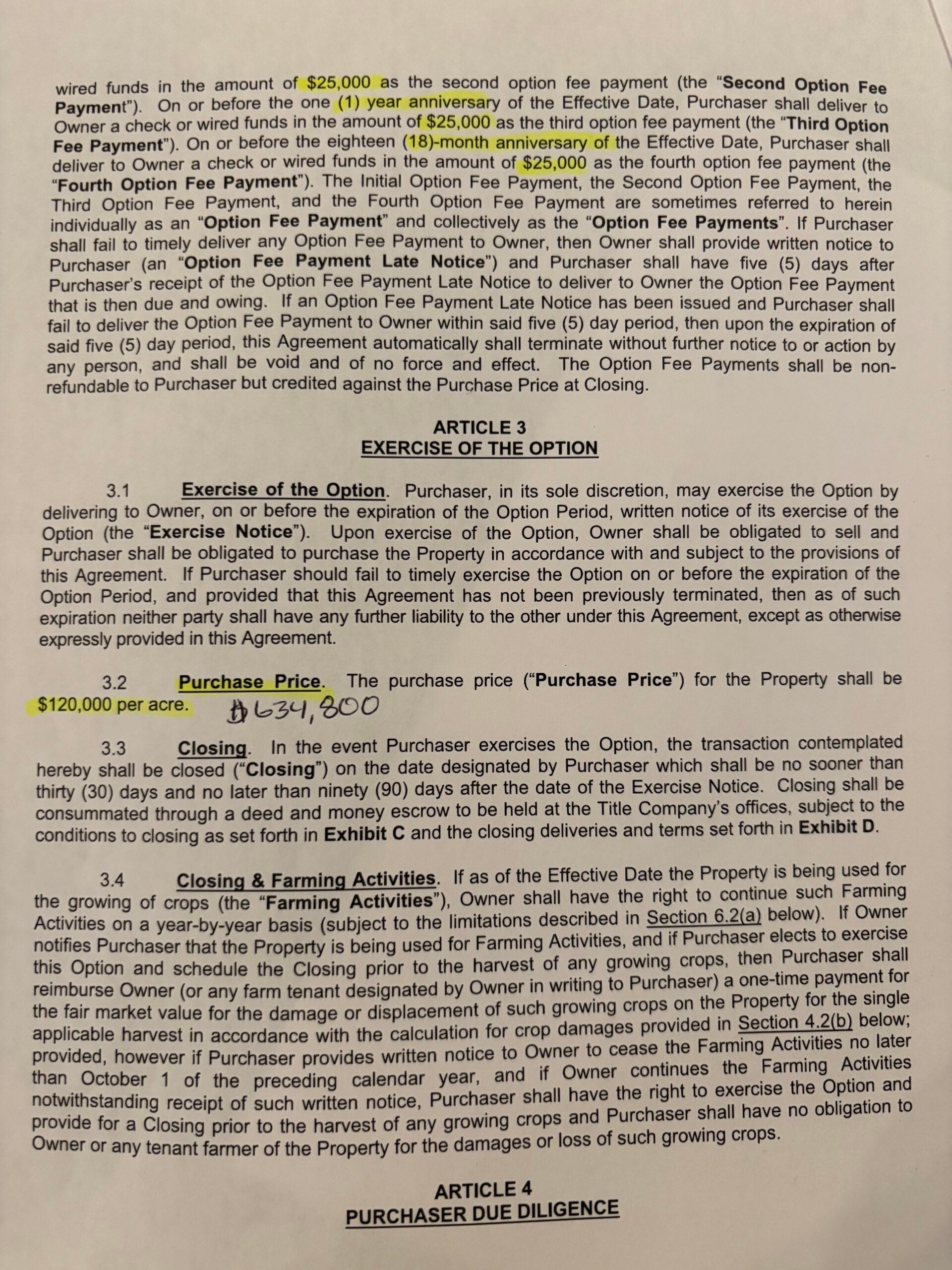
In Pennsylvania, a farmer rejected $15m in January for land he'd worked for 50 years. A Wisconsin farmer turned down $80m the same month. Other landowners have declined offers exceeding $120,000 per acre -- prices unimaginable just a few years ago. The rebuffs are a jarring reminder of AI's physical bounds, and limits of the dollars behind the technology. [...] As AI promises to transcend corporeal fallibility, these standoffs reveal its very physical constraints -- and Wall Street's miscalculation of what some people value most. In the rolling hills of Mason county and farmland across America, that gap is measured not in dollars but in something harder to price: identity.

Hardware

ASML Unveils EUV Light Source Advance That Could Yield 50% More Chips By 2030 (reuters.com) 26

An anonymous reader quotes a report from Reuters: Researchers at ASML Holding say they have found a way to boost the power of the light source in a key chip making machine to turn out up to 50% more chips by decade's end, to help retain the Dutch company's edge over emerging U.S. and Chinese rivals. ASML is the world's only maker of commercial extreme ultraviolet lithography (EUV) machines, a critical tool for chipmakers such as TSMC, Intel and others in producing advanced computing chips. "It's not a parlor trick or something like this, where we demonstrate for a very short time that it can work," Michael Purvis, ASML's lead technologist for its EUV source light, said in an interview. "It's a system that can produce 1,000 watts under all the same requirements that you could see at a customer," he added, speaking at the company's California facilities near San Diego. [...]

With the technological advance revealed on Monday, which is being reported here for the first time, ASML aims to outdistance any would-be rivals by improving the most technologically challenging aspect of the machines. This is the quest to generate EUV light with the right power and properties to turn out chips at high volume. The company's researchers have found a way to boost the power of the EUV light source to 1,000 watts from 600 watts now. The chief advantage is that greater power translates into the ability to make more chips every hour, helping to lower the cost of each. Chips are printed similar to a photograph, where the EUV light is shone on a silicon wafer coated with special chemicals called a photoresist. With a more powerful EUV light source, chip factories need shorter exposure times. "We'd like to make sure that our customers can keep on using EUV at a much lower cost," Teun van Gogh, executive vice president for the NXE line of EUV machines at ASML, told Reuters. Van Gogh said customers should be able to process about 330 silicon wafers an hour on each machine by the end of the decade, up from 220 now. Depending on the size of a chip, each wafer can hold anywhere from scores to thousands of the devices.

ASML got the power boost by doubling down on an approach that already places its machines among the most complex inventions of humans. To produce light with a wavelength of 13.5 nanometers, ASML's machine shoots a stream of molten droplets of tin through a chamber, where a massive carbon dioxide laser heats them into plasma. This is a superheated state of matter in which the tin droplets become hotter than the sun and emit EUV light, to be collected by precision optic equipment supplied by Germany's Carl Zeiss AG and fed into the machine to print chips. The key advancements in Monday's disclosure involved doubling the number of tin drops to about 100,000 every second, and shaping them into plasma using two smaller laser bursts, as opposed to today's machines that use a single shaping burst. [...] ASML believes the techniques it used to hit 1,000 watts will unlock continued advances in the future, Purvis said, adding, "We see a reasonably clear path toward 1,500 watts, and no fundamental reason why we couldn't get to 2,000 watts."

AI

Sam Altman Would Like To Remind You That Humans Use a Lot of Energy, Too (techcrunch.com) 142

OpenAI CEO Sam Altman is pushing back on growing concerns about AI's environmental footprint, dismissing claims about ChatGPT's water consumption as "totally fake" and arguing that the fairer way to measure AI's energy use is to compare it against humans.

In an interview with Indian Express, Altman acknowledged that evaporative cooling in data centers once made water usage a real concern but said that is no longer the case, calling internet claims of 17 gallons of water per query "completely untrue, totally insane, no connection to reality."

On energy, he conceded it is "fair" to worry about total consumption given how heavily the world now relies on AI, and called for a rapid shift toward nuclear, wind and solar power. He took particular issue with comparisons that pit the cost of training a model against a single human inference, noting it "takes like 20 years of life and all of the food you eat" before a person gets smart -- and that on a per-query basis, AI has "probably already caught up on an energy efficiency basis."
AI

Raspberry Pi Stock Rises Over Its Possible Use With OpenClaw's AI Agents (reuters.com) 46

This week Raspberry Pi saw its stock price surge more than 60% above its early-February low (before giving up some gains at the end of the week). Reuters notes the rise started when CEO Eben Upton bought 13,224 pounds worth of shares — but there could be another reason. "The rally in the roughly $800 million company has materialised alongside social-media buzz that demand for its single-board computers could pick up as people buy them to run AI agents such as OpenClaw."

The Register explains: The catalyst appears to have been the sudden realization by one X user, "aleabitoreddit," that the agentic AI hand grenade known as OpenClaw could drive demand for Raspberry Pis the way it had for Apple Mac Minis. The viral AI personal assistant, formerly known as Clawdbot and Moltbot, has dominated the feeds of AI boosters over the past few weeks for its ability to perform everyday tasks like sending emails, managing calendars, booking appointments, and complaining about their meatbag masters on the purportedly all-agent forum known as MoltBook... In case it needs to be said, no one should be running this thing on their personal devices lest the agent accidentally leak your most personal and sensitive secrets to the web... In this context, a cheap low-power device like a Raspberry Pi makes a certain kind of sense as a safer, saner way to poke the robo-lobster...
The Register argues Raspberry Pis aren't as cheap as they used to be "thanks in part to the global memory crunch. Today, a top-specced Raspberry Pi 5 with 16GB of memory will set you back more than $200, up from $120 a year ago."

"You know what's cheaper, easier, and more secure than letting OpenClaw loose on your local area network? A virtual private cloud..."
Programming

Has the AI Disruption Arrived - and Will It Just Make Software Cheaper and More Accessible? (aboard.com) 88

Programmer/entrepreneur Paul Ford is the co-founder of AI-driven business software platform Aboard. This week he wrote a guest essay for the New York Times titled "The AI Disruption Has Arrived, and It Sure Is Fun," arguing that Anthropic's Claude Code "was always a helpful coding assistant, but in November it suddenly got much better, and ever since I've been knocking off side projects that had sat in folders for a decade or longer... [W]hen the stars align and my prompts work out, I can do hundreds of thousands of dollars worth of work for fun (fun for me) over weekends and evenings, for the price of the Claude $200-a-month."

He elaborates on his point on the Aboard.com blog: I'm deeply convinced that it's possible to accelerate software development with AI coding — not deprofessionalize it entirely, or simplify it so that everything is prompts, but make it into a more accessible craft. Things which not long ago cost hundreds of thousands of dollars to pull off might come for hundreds of dollars, and be doable by you, or your cousin. This is a remarkable accelerant, dumped into the public square at a bad moment, with no guidance or manual — and the reaction of many people who could gain the most power from these tools is rejection and anxiety. But as I wrote....

I believe there are millions, maybe billions, of software products that don't exist but should: Dashboards, reports, apps, project trackers and countless others. People want these things to do their jobs, or to help others, but they can't find the budget. They make do with spreadsheets and to-do lists.

I don't expect to change any minds; that's not how minds work. I just wanted to make sure that I used the platform offered by the Times to say, in as cheerful a way as possible: Hey, this new power is real, and it should be in as many hands as possible. I believe everyone should have good software, and that it's more possible now than it was a few years ago.

From his guest essay: Is the software I'm making for myself on my phone as good as handcrafted, bespoke code? No. But it's immediate and cheap. And the quantities, measured in lines of text, are large. It might fail a company's quality test, but it would meet every deadline. That is what makes A.I. coding such a shock to the system... What if software suddenly wanted to ship? What if all of that immense bureaucracy, the endless processes, the mind-boggling range of costs that you need to make the computer compute, just goes?

That doesn't mean that the software will be good. But most software today is not good. It simply means that products could go to market very quickly. And for lots of users, that's going to be fine. People don't judge A.I. code the same way they judge slop articles or glazed videos. They're not looking for the human connection of art. They're looking to achieve a goal. Code just has to work... In about six months you could do a lot of things that took me 20 years to learn. I'm writing all kinds of code I never could before — but you can, too. If we can't stop the freight train, we can at least hop on for a ride.

The simple truth is that I am less valuable than I used to be. It stings to be made obsolete, but it's fun to code on the train, too. And if this technology keeps improving, then all of the people who tell me how hard it is to make a report, place an order, upgrade an app or update a record — they could get the software they deserve, too. That might be a good trade, long term.

AI

America's Peace Corps Announces 'Tech Corps' Volunteers to Help Bring AI to Foreign Countries (engadget.com) 49

Over 240,000 Americans volunteered for Peace Corps projects in 142 countries since the program began more than half a century ago.

But now the agency is launching a new initiative — called Tech Corps. "It's the Peace Corps, but make it AI," explains Engadget: The Peace Corps' latest proposal will recruit STEM graduates or those with professional experience in the artificial intelligence sector and send them to participating host countries.

According to the press release, volunteers will be placed in Peace Corps countries that are part of the American AI Exports Program, which was created last year from an executive order from President Trump as a way to bolster the US' grip on the AI market abroad. Tech Corps members will be tasked with using AI to resolve issues related to agriculture, education, health and economic development. The program will offer its members 12- to 27-month in-person assignments or virtual placements, which will include housing, healthcare, a living stipend and a volunteer service award if the corps member is placed overseas.

"American technology to power prosperity," reads the headline at Tech Corps web site. ("Build the tech nations depend on... See the world. Be the future."

The site says they're recruiting "service-minded technologists to serve in the Peace Corps to help countries around the world harness American AI to enhance opportunity and prosperity for their citizens." (And experienced technology professionals can donate 5-15 hours a week "to mentor and support projects on-the-ground.")
Power

US Particle Accelerators Turn Nuclear Waste Into Electricity, Cut Radioactive Life By 99.7% (interestingengineering.com) 67

Researchers at the Thomas Jefferson National Accelerator Facility are advancing Accelerator-Driven Systems (ADS) that use high-energy proton beams to transmute long-lived nuclear waste into shorter-lived isotopes. "The process also generates significant heat, which can be harnessed to produce additional electricity for the grid," reports Interesting Engineering. The projects are supported by $8.17 million in grants from the Department of Energy's NEWTON (Nuclear Energy Waste Transmutation Optimized Now) program. From the report: The researchers are developing ADS technology. This system uses a particle accelerator to fire high-energy protons at a target (such as liquid mercury), triggering a process called "spallation." This releases a flood of neutrons that interact with unwanted, long-lived isotopes in nuclear waste. The technology can effectively "burn" the most hazardous components of the waste by transmuting these elements. While unprocessed fuel remains dangerous for approximately 100,000 years, partitioning and recycling via ADS can reduce that window to just 300 years. [...]

To make ADS economically viability, Jefferson Lab is tackling two primary technical hurdles: efficiency and power. Traditional particle accelerators require massive, expensive cryogenic cooling systems to reach superconducting temperatures. Jefferson Lab is pioneering a more cost-effective approach by coating the interior of pure niobium cavities with tin. These niobium-tin cavities can operate at higher temperatures, allowing for the use of standard commercial cooling units rather than custom, large-scale cryogenic plants. The team is also developing spoke cavities, which is a complex design intended to drive even higher efficiency in neutron spallation.

The second project focuses on the power source behind the beam. Researchers are adapting the magnetron -- the same component that powers microwave ovens -- to provide the 10 megawatts of power required for ADS. The primary challenge is that the energy frequency must match the accelerator cavity precisely at 805 Megahertz. In collaboration with Stellant Systems, researchers are prototyping advanced magnetrons that can be combined to reach the necessary high-power thresholds with maximum efficiency. The NEWTON program aims to enable the recycling of the entire US commercial nuclear fuel stockpile within the next 30 years.

The Courts

US Supreme Court Rejects Trump's Global Tariffs (reuters.com) 228

The U.S. Supreme Court struck down on Friday President Donald Trump's sweeping tariffs that he pursued under a law meant for use in national emergencies, rejecting one of his most contentious assertions of his authority in a ruling with major implications for the global economy. From a report: The justices, in a 6-3 ruling authored by conservative Chief Justice John Roberts, upheld a lower court's decision that the Republican president's use of this 1977 law exceeded his authority.

The court ruled that the Trump administration's interpretation that the law at issue - the International Emergency Economic Powers Act, or IEEPA - grants Trump the power he claims to impose tariffs would intrude on the powers of Congress and violate a legal principle called the "major questions" doctrine. The doctrine, embraced by the conservative justices, requires actions by the government's executive branch of "vast economic and political significance" to be clearly authorized by Congress. The court used the doctrine to stymie some of Democratic former President Joe Biden's key executive actions.

Printer

California's New Bill Requires DOJ-Approved 3D Printers That Report on Themselves (adafruit.com) 123

California's recently-proposed AB-2047 would require 3D printers sold in the state to be DOJ-approved models equipped with "firearm blocking technology," banning non-certified machines after 2029 and criminalizing efforts to bypass the software. Adafruit notes that unlike similar legislation proposed in Washington State and New York, California's version "adds a certification bureaucracy on top: state-approved algorithms, state-approved software control processes, state-approved printer models, quarterly list updates, and civil penalties up to $25,000 per violation." From the report: Assembly Member Bauer-Kahan introduced AB-2047, the "California Firearm Printing Prevention Act," on February 17th. The bill would ban the sale or transfer of any 3D printer in California unless it appears on a state-maintained roster of approved makes and models... certified by the Department of Justice as equipped with "firearm blocking technology." Manufacturers would need to submit attestations for every make and model. The DOJ would publish a list. If your printer isn't on the list by March 1, 2029, it can't be sold. In addition, knowingly disabling or circumventing the blocking software is a misdemeanor.

[...] As Michael Weinberg wrote after the New York and Washington proposals dropped⦠accurately identifying gun parts from geometry alone is incredibly hard, desktop printers lack the processing power to run this kind of analysis, and the open-source firmware that runs most machines makes any blocking requirement trivially easy to bypass. The Firearms Policy Coalition flagged AB-2047 on X, and the reactions tell you everything. Jon Lareau called it "stupidity on steroids," pointing out that a simple spring-shaped part has no way of revealing its intended use. The Foundry put it plainly: "Regulating general-purpose machines is another. AB-2047 would require 3D printers to run state-approved surveillance software and criminalize modifying your own hardware."

Transportation

Vermont EV Buses Prove Unreliable For Transportation This Winter (vermontdailychronicle.com) 141

An anonymous reader writes:

Electric buses are proving unreliable this winter for Vermont's Green Mountain Transit, as it needs to be over 41 degrees for the buses to charge, but due to a battery recall the buses are a fire hazard and can't be charged in a garage.

Spokesman for energy workers advocacy group Power the Future Larry Behrens told the Center Square: "Taxpayers were sold an $8 million 'solution' that can't operate in cold weather when the home for these buses is in New England."

"We're beyond the point where this looks like incompetence and starts to smell like fraud," Behrens said.

"When government rushes money out the door to satisfy green mandates, basic questions about performance, safety, and value for taxpayers are always pushed aside," Behrens said. "Americans deserve to know who approved this purchase and why the red flags were ignored."

General manager at Green Mountain Transit (GMT) Clayton Clark told The Center Square that "the federal government provides public transit agencies with new buses through a competitive grant application process, and success is not a given."


Medicine

Air Pollution Emerges As a Direct Risk Factor For Alzheimer's Disease 34

Longtime Slashdot reader walterbyrd shares a report from ABC News: In a study of nearly 28 million older Americans, long-term exposure to fine particle air pollution raised the risk of Alzheimer's disease. That link held even after researchers accounted for common conditions like high blood pressure, stroke and depression. Fine particle air pollution, known as PM2.5, consists of tiny particles in the air that come from car exhaust, power plants, wildfires, and burning fuels, according to the American Lung Association. They are small enough to travel deep into the lungs and even reach the bloodstream.

The research, conducted at Emory University and published in PLOS Medicine, tracked health data over nearly two decades to explore whether air pollution harms the brain indirectly by causing high blood pressure or heart disease, which, in turn, leads to dementia. However, these "middleman" conditions accounted for less than 5% of the connection between pollution and Alzheimer's, the research found. The researchers say this suggests that over 95% of the Alzheimer's risk comes from the direct impact of breathing in dirty air, likely through inflammation or damage to brain cells.
"The relationship between PM2.5 and AD [Alzheimer's disease] has been shown to be pretty much linear," said Kyle Steenland, a professor in the departments of environmental health and epidemiology at the Rollins School of Public Health at Emory University, and senior author of the study. "The reason this is particularly important is that PM2.5 is known to be associated with high blood pressure, stroke and depression -- all of which are associated with AD. So, from a prevention standpoint, simply treating these diseases will not get rid of the problem. We have to address exposure to PM2.5."
AI

Apple Is Reportedly Planning To Launch AI-Powered Glasses, a Pendant, and AirPods 34

According to Bloomberg's Mark Gurman (paywalled), Apple is reportedly developing AI-powered smart glasses, a wearable pendant, and camera-equipped AirPods that connect to the iPhone and use "visual context" to let Siri perform real-world actions. The Verge reports: Apple is reportedly aiming to start production of its smart glasses in December, ahead of a 2027 launch. The new device will compete directly with Meta's lineup of smart glasses and is rumored to feature speakers, microphones, and a high-resolution camera for taking photos and videos, in addition to another lens designed to enable AI-powered features.

The glasses won't have a built-in display, but they will allow users to make phone calls, interact with Siri, play music, and "take actions based on surroundings," such as asking about the ingredients in a meal, according to Bloomberg. Apple's smart glasses could also help users identify what they're seeing, reference landmarks when offering directions, and remind wearers to complete a task in specific situations, Bloomberg reports.

The company is reportedly planning to develop the frames for the smart glasses in-house, instead of partnering with a third-party company like Meta does with Ray-Ban and Oakley. Prototypes of the glasses use a cable to connect to a battery pack and an iPhone, but Bloomberg reports that "newer versions have the components embedded in the frame." Apple reportedly wants to make its smart glasses stand out by offering a high-quality build and advanced camera technology. The company is still working on AI-powered smart glasses with a display, though their launch "remains many years away," Bloomberg says.

Apple's plans for AI hardware don't end there, as the company is expected to build upon its Google Gemini-powered Siri upgrade with an AirTag-sized AI pendant that people can either wear as a necklace or a pin. This device would "essentially serve as an always-on camera" for the iPhone and has a microphone for prompting Siri, Bloomberg reports. The pendant, which The Information first reported on last month, is rumored to come with a built-in chip, but will mainly rely on the iPhone's processing power. The device could arrive as early as next year, according to Bloomberg.
The Courts

NPR's Radio Host David Greene Says Google's NotebookLM Tool Stole His Voice 24

An anonymous reader quotes a report from the Washington Post: David Greene had never heard of NotebookLM, Google's buzzy artificial intelligence tool that spins up podcasts on demand, until a former colleague emailed him to ask if he'd lent it his voice. "So... I'm probably the 148th person to ask this, but did you license your voice to Google?" the former co-worker asked in a fall 2024 email. "It sounds very much like you!"

Greene, a public radio veteran who has hosted NPR's "Morning Edition" and KCRW's political podcast "Left, Right & Center," looked up the tool, listening to the two virtual co-hosts -- one male and one female -- engage in light banter. "I was, like, completely freaked out," Greene said. "It's this eerie moment where you feel like you're listening to yourself." Greene felt the male voice sounded just like him -- from the cadence and intonation to the occasional "uhhs" and "likes" that Greene had worked over the years to minimize but never eliminated. He said he played it for his wife and her eyes popped.

As emails and texts rolled in from friends, family members and co-workers, asking if the AI podcast voice was his, Greene became convinced he'd been ripped off. Now he's suing Google, alleging that it violated his rights by building a product that replicated his voice without payment or permission, giving users the power to make it say things Greene would never say. Google told The Washington Post in a statement on Thursday that NotebookLM's male podcast voice has nothing to do with Greene. Now a Santa Clara County, California, court may be asked to determine whether the resemblance is uncanny enough that ordinary people hearing the voice would assume it's his -- and if so, what to do about it.
Greene's lawsuit cites an unnamed AI forensic firm that used its software to compare the artificial voice to Greene's. It gave a confidence rating of 53-60% that Greene's voice was used to train the model, which it considers "relatively high" confidence.

"If I was David Greene I would be upset, not just because they stole my voice," but because they used it to make the podcasting equivalent of AI "slop," said Mike Pesca, host of "The Gist" podcast and a former colleague of Greene's at NPR. "They have banter, but it's very surface-level, un-insightful banter, and they're always saying, 'Yeah, that's so interesting.' It's really bad, because what do we as show hosts have except our taste in commentary and pointing our audience to that which is interesting?"
AI

Microsoft's AI Chief Says All White-Collar Desk Work Will Be Automated Within 18 Months (fortune.com) 150

Microsoft AI CEO Mustafa Suleyman expects "human-level performance on most, if not all professional tasks" from AI, and believes most work involving "sitting down at a computer" -- accounting, legal, marketing, project management -- will be fully automated within the next year or 18 months. He pointed to exponential growth in computational power and predicted that creating a new AI model will soon be as easy as "creating a podcast or writing a blog."
Data Storage

Micron's PCIe 6.0 SSD Hits Mass Production at 28 GB/s (tomshardware.com) 30

Micron has begun mass production of the 9650 series, the industry's first PCIe 6.0 SSD, capable of sequential read speeds up to 28 GB/s and random read performance of 5.5 million IOPS -- roughly double the throughput of the fastest PCIe 5.0 drives available today.

The drive targets AI and data center workloads and ships in E1.S and E3.S form factors across two variants: the Pro, available in capacities up to 30.72 TB, and the endurance-oriented Max, topping out at 25.6 TB. Both variants share the same peak sequential and random speeds but diverge on mixed workloads and endurance ratings -- the Max 25.6 TB carries a random endurance rating of 140,160 TBW compared to 56,064 TBW on the Pro 30.72 TB.

Power draw holds at 25 watts, unchanged from high-end PCIe 5.0 enterprise SSDs, though the 9650 is Micron's first drive to support liquid cooling alongside air. Consumer platforms are not expected to adopt PCIe 6.0 until 2030.
Social Networks

Instagram Boss Says 16 Hours of Daily Use Is Not Addiction (bbc.com) 62

Instagram head Adam Mosseri told a Los Angeles courtroom last week that a teenager's 16-hour single-day session on the platform was "problematic use" but not an addiction, a distinction he drew repeatedly during testimony in a landmark trial over social media's harm to minors.

Mosseri, who has led Instagram for eight years, is the first high-profile tech executive to take the stand. He agreed the platform should do everything in its power to protect young users but said how much use was too much was "a personal thing." The lead plaintiff, identified as K.G.M., reported bullying on Instagram more than 300 times; Mosseri said he had not known. An internal Meta survey of 269,000 users found 60% had experienced bullying in the previous week.
Linux

'I Tried Running Linux On an Apple Silicon Mac and Regretted It' (msn.com) 157

Installing Linux on a MacBook Air "turned out to be a very underwhelming experience," according to the tech news site MakeUseOf: The thing about Apple silicon Macs is that it's not as simple as downloading an AArch64 ISO of your favorite distro and installing it. Yes, the M-series chips are ARM-based, but that doesn't automatically make the whole system compatible in the same way most traditional x86 PCs are. Pretty much everything in modern MacBooks is custom. The boot process isn't standard UEFI like on most PCs. Apple has its own boot chain called iBoot. The same goes for other things, like the GPU, power management, USB controllers, and pretty much every other hardware component. It is as proprietary as it gets.

This is exactly what the team behind Asahi Linux has been working toward. Their entire goal has been to make Linux properly usable on M-series Macs by building the missing pieces from the ground up. I first tried it back in 2023, when the project was still tied to Arch Linux and decided to give it a try again in 2026. These days, though, the main release is called Fedora Asahi Remix, which, as the name suggests, is built on Fedora rather than Arch...

For Linux on Apple Silicon, the article lists three major disappointments:
  • "External monitors don't work unless your MacBook has a built-in HDMI port."
  • "Linux just doesn't feel fully ready for ARM yet. A lot of applications still aren't compiled for ARM, so software support ends up being very hit or miss." (And even most of the apps tested with FEX "either didn't run properly or weren't stable enough to rely on.")
  • Asahi "refused to connect to my phone's hotspot," they write (adding "No, it wasn't an iPhone").

Slashdot Top Deals